
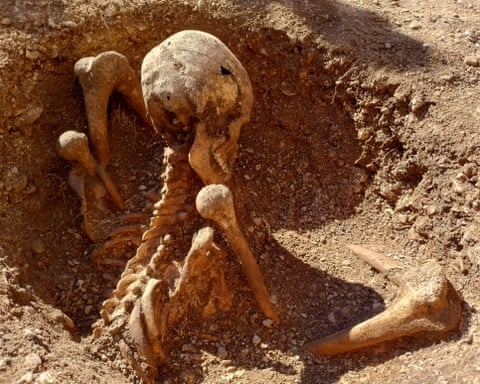
Archaeologists in the eastern French city of Dijon have uncovered a series of ancient burials with a puzzling characteristic: the skeletons were interred in a seated position. The latest discovery was made adjacent to a local primary school, where a remarkably well-preserved skeleton was found positioned upright at the bottom of a circular pit.
This find is part of a broader pattern. Earlier this month, four similar burials were unearthed nearby, and last year, thirteen others were discovered approximately twenty meters away at the same development site. All the remains are oriented in the same manner, with their backs against the eastern wall of the pit and facing westward. Scientific analysis dates these individuals to a period between 300 and 200 BC.
The burials are attributed to the Gauls, a Celtic civilization that flourished across parts of modern Western Europe. While Dijon is known to have been a significant Gallic settlement, many aspects of their culture remain obscure, largely filtered through the accounts of their Roman conquerors.
The concentration of these “seated burials” in Dijon is notable. Including earlier finds, about twenty such tombs have been identified in a small area of the city center. This represents a significant portion of the fewer than eighty similar burials documented globally.
The circumstances surrounding the interments are a subject of intense study. The group consists entirely of adult males, with the exception of one child found decades prior. Examinations of their remains indicate signs of osteoarthritis, pointing to lives of strenuous physical labor. Five of the individuals show evidence of violent trauma.
A key mystery is the reason for this distinctive burial practice. Researchers are investigating whether it represented a form of posthumous honor, a ritual practice, or perhaps a punishment. Notably, the graves contained almost no personal artifacts or offerings, with only a single armband helping to confirm the period.
Specialists involved in the excavation acknowledge the frustration of incomplete evidence, noting that crucial contextual layers above the tombs are missing. The ongoing investigation aims to piece together a clearer picture of this enigmatic funerary tradition and the community that practiced it.
