
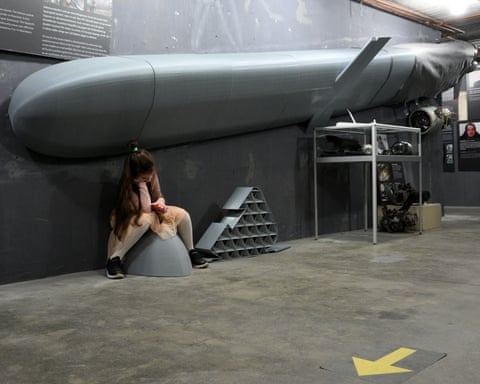
A former World War II air-raid shelter in the heart of Berlin now houses a stark and visceral exhibition dedicated to the ongoing conflict in Ukraine. The privately funded institution, described by its founders as a “living, moving exhibition,” aims to combat public fatigue by immersing visitors in the brutal reality faced by Ukrainians daily.
Upon entry, guests are immediately confronted by a simulated first-person view from a Russian drone, framing them as potential targets. This sets the tone for a collection assembled with the assistance of Ukraine’s National Military History Museum and soldiers from the front lines. The exhibits chronicle the invasion’s origins and impact through destroyed military hardware, photographs of devastation, and personal stories.
Central to the display is the wreckage of a silver-grey Fiat van, a former “social taxi” used to evacuate the elderly and transport children in Kherson. It was struck by a drone in April 2025, an attack captured on the drone’s own camera and later traced by Ukrainian intelligence. The incident killed a 28-year-old aid worker, whose image was subsequently used in Russian propaganda.
The ceiling is hung with twenty captured Russian drones, including low-cost models constructed from everyday items like duct tape and disposable cameras, repurposed to drop grenades on civilians. A large, reconstructed cruise missile, printed in 3D after import restrictions blocked the original, dominates one space, accompanied by a photo of a Kyiv apartment block it destroyed.
The curators, who regularly travel to Ukraine to deliver aid, are explicit about their non-neutral stance. The exhibition criticizes political figures in Germany and elsewhere who downplay the threat posed by Russia, featuring blunt slogans like “Help or be an arsehole.” They have previously gained attention for placing a destroyed Russian tank outside the Russian embassy in Berlin.
A former Ukrainian deputy defense minister involved with the project offered a pointed piece of advice to Germany: “Whatever you do, don’t get rid of your bunkers.” The museum is planned to remain open for at least the duration of the war, serving as a stark reminder of a conflict its creators say Europe cannot afford to ignore.
