
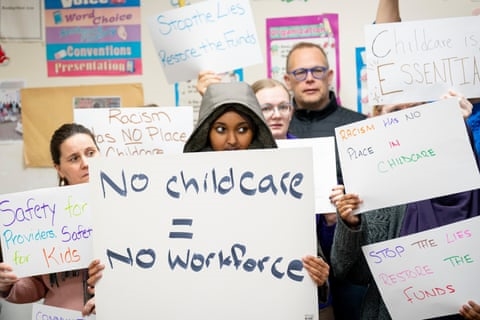
A move by the federal government to suspend key childcare and family assistance funds in five states is creating widespread alarm among providers and the families who depend on the programs. The action, justified by unsubstantiated allegations of systemic fraud, threatens to destabilize a critical support system.
The funding at risk, which includes billions from the Child Care and Development Fund and Temporary Assistance for Needy Families programs, supports low-income working families in California, Colorado, Illinois, Minnesota, and New York. A federal review is now underway, leaving the future of these allocations uncertain.
Childcare professionals across the affected states report that the potential freeze has triggered immediate anxiety. Many describe the funding as a lifeline not only for their businesses but for the broader local economy. “This support network enables the workforce of an entire state to function,” explained one provider, who noted that closures would force parents into “impossible choices” between employment and care for their children.
The administration’s decision appears linked to a narrative of fraud that providers call misleading. While referencing a separate, prosecuted fraud case involving a pandemic-era meals program, officials have offered no evidence of wrongdoing within the state childcare systems in question. This conflation has drawn sharp criticism.
“It’s extraordinarily stressful to see a misleading narrative adopted at the federal level, resulting in a threat to funds for an entire state,” said a Minnesota-based childcare worker. “We’ve fought for professional recognition for decades, and now we’re forced to defend ourselves against being framed as criminals.”
The financial stakes are high for an industry already under strain. Nationally, childcare costs outpace inflation, and most states have fewer providers now than before the pandemic. Many workers in the field rely on the very assistance programs they help facilitate. “This is my career and my sole income,” stated a provider with thirty years of experience. “A freeze doesn’t just hurt centers; it directly cuts off assistance to families, which will push parents out of the workforce.”
In response, the five states have obtained a temporary court order blocking the freeze and are pursuing a more permanent injunction, arguing the action lacks evidence and may violate federal law. A spokesperson for the Department of Health and Human Services defended the review as a necessary step to protect taxpayers from “waste, fraud, and abuse,” labeling the legal challenge a partisan maneuver.
As the court case proceeds, childcare providers and the families they serve face an anxious wait, concerned about the stability of an essential public service.
